Using history, environmental scanning, and strategic foresight to examine a mature sector under structural pressure.
Higher education was facing converging demographic, technological, economic, and cultural pressures, often discussed as separate problems. I developed a three-part research and foresight series to examine the system as a whole: how it developed, where the existing model was under strain, and what emerging alternatives could mean for its future.
Strategic Questions
- How did we get here?
- Where are we now?
- What might come next?
Rather than treating current challenges in isolation, I used these three questions to examine the system across time and connect present conditions to possible future states.
How I Approached the Work
- Historical Context: Which assumptions and structures had become embedded in the model?
- Environmental Scanning: Which demographic, economic, technological, workforce, and cultural forces were changing?
- Pattern Identification: Where were multiple pressures pointing to the same underlying issue?
- Future Possibilities: Which emerging models challenged current assumptions?
- Strategic Implications: What should leaders be considering now?
PAST: System Development
I traced how key features of the current model developed over time, including the credit hour, governance, administration, student services, cost, and institutional purpose. The research helped distinguish enduring elements of the mission from structures shaped by particular historical conditions.
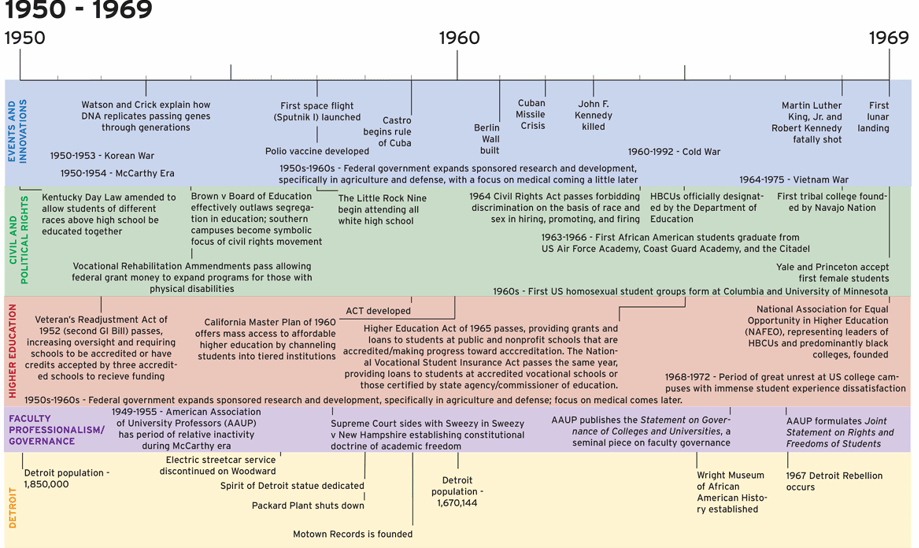
- Some familiar structures are conventions, not inevitabilities. The credit hour, for example, originated as a measure of time and became deeply embedded in how learning is organized.
- The institutional model accumulated over time. Governance, administration, and student services evolved in response to changing expectations and pressures.
- The definition of institutional purpose expanded. Higher education came to carry overlapping expectations around learning, employment, research, community, and student experience.
Understanding what was inherited made it easier to ask what still served the system and what could be reconsidered.
PRESENT: System Pressures
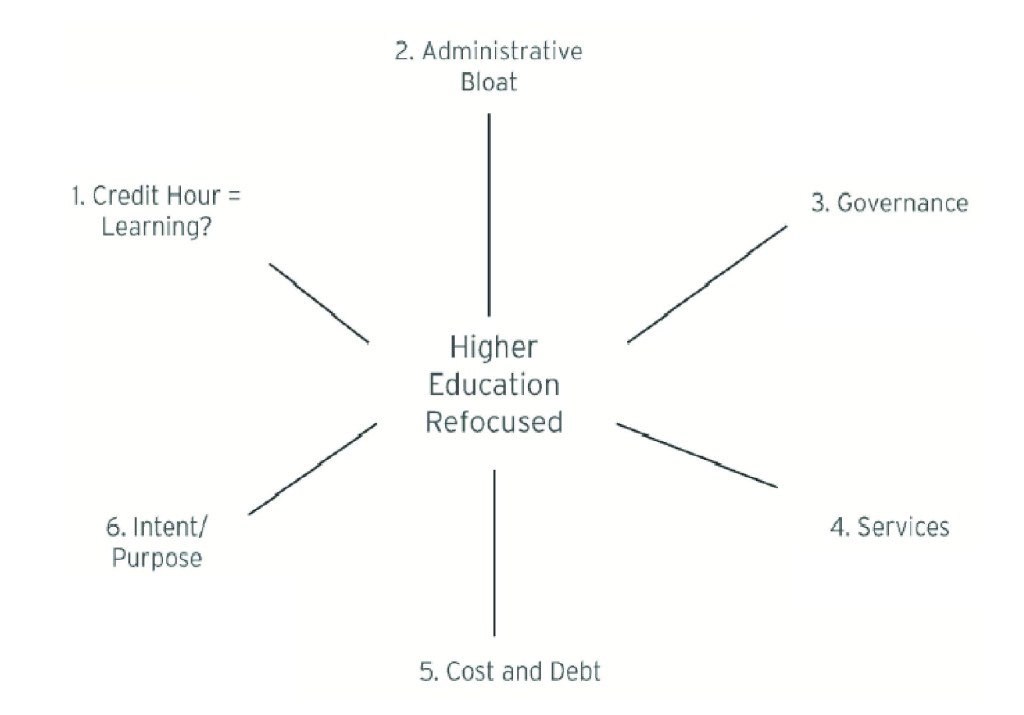
The current-state analysis showed that demographic change, affordability, learner expectations, institutional economics, governance, and new forms of competition were not isolated challenges. Together, they were placing pressure on the underlying operating model.
- Demographics: changing assumptions about future enrollment and demand
- Affordability and Value: greater scrutiny of cost, debt, and return-on-investment
- Learner Expectations: growing interest in online, competency-based, short-form, and alternative pathways
- Institutional Economics: pressure toward reorganization, partnerships, consolidation, and new revenue models
- Governance and Purpose: increasingly difficult questions about who decides, what institutions are responsible for, and which outcomes matter
Viewed separately, these looked like individual challenges. Viewed together, they suggested pressure on the model itself.
FUTURE: What May Emerge
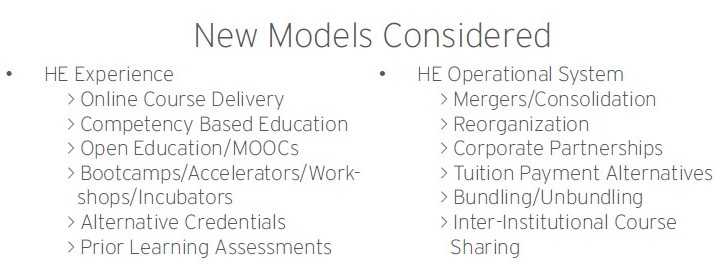
I then looked beyond immediate pressures to the models and structural forces that could reshape both the learner experience and institutional operations. The purpose was to identify plausible directions of change, rather than a single predicted future.
Experience models
How might people access, combine, and demonstrate learning differently? The research considered online delivery, competency-based education, alternative credentials, prior-learning assessment, and other pathways outside the traditional degree model.
Operating models
How might institutions organize and deliver value differently? Possibilities included consolidation, reorganization, partnerships, alternative payment models, unbundled services, and course sharing.
Structural forces
What could accelerate change? The scan considered technology, economics, demographics, social expectations, and political conditions that could alter both institutional capacity and stakeholder expectations.
Strategic Implications
Foresight is most useful when it improves present-day decisions. Bringing historical context, current pressures, and plausible alternatives together made different strategic choices easier to see.
- Separate mission from model. Not every feature of the current system is essential to the mission; some reflect historical choices and conditions.
- Treat converging pressures as a system problem. Demographics, economics, technology, learner expectations, and institutional structure interact rather than operating independently.
- Use foresight to expand the decision space. Emerging models matter not because they provide one answer, but because they expose different assumptions and options.
What I Brought to the Work
My role
Research Design · Historical Analysis · Environmental Scanning · Trend Research · Strategic Foresight · Systems Analysis · Executive Narrative Development
Deliverable
A three-part research and foresight series examining the past, present, and potential future of a sector undergoing structural change.
Explore the Source Material
The case study draws from a three-part research and foresight series developed in 2022. The original presentations contain the fuller analysis, research, and citations.
- Part I: Past
How the higher education system developed and which assumptions became embedded. - Part II: Current State
Where the model was under strain and how institutions were responding. - Part III: Future Trends
Structural forces, emerging models, and potential implications for the sector.
 Ashlei Watson
Leave a comment