Research · Foresight · Workforce Strategy
College for Creative Studies · Self-Initiated Research · Spring 2022
I initiated this research project at the College for Creative Studies to explore a shift in how we prepare people for work: from emphasizing what someone knows to considering what they are able to do with that knowledge.
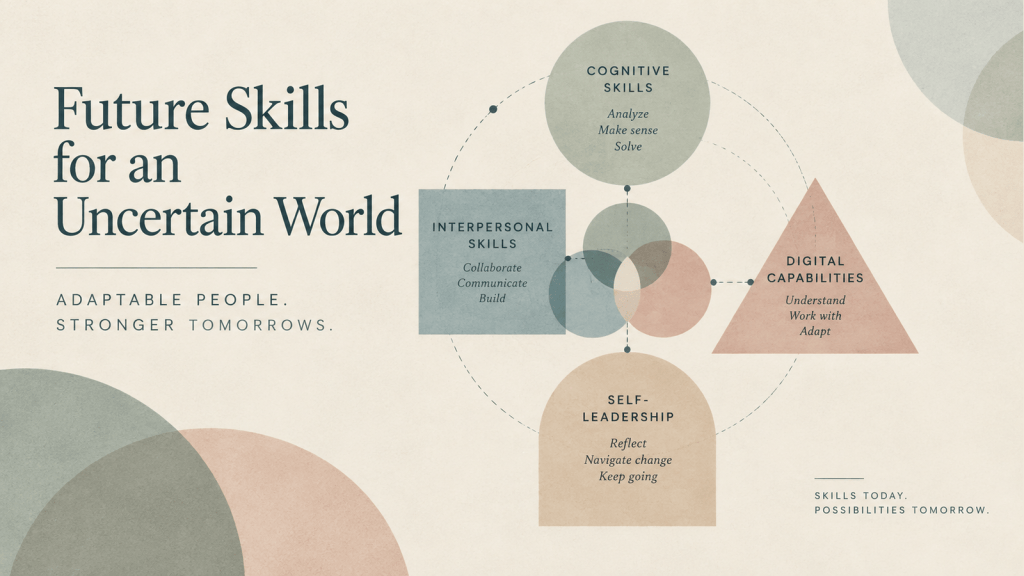
I compared multiple future-of-work and skills frameworks to identify capabilities that appeared consistently across different sources and scenarios. The patterns pointed toward four broad areas: cognitive skills, interpersonal skills, self-leadership, and digital capabilities.
The larger question was not simply which skills employers might want next. It was how education and workforce development could help people build a portfolio of capabilities that remains useful as jobs, technologies, and social conditions continue to change.
The Challenge
Traditional approaches to career preparation have often treated subject-area knowledge and degree attainment as proxies for readiness. But the research I reviewed pointed to a more complicated picture: employers were increasingly emphasizing capabilities that could be applied across roles and contexts, while technological and societal change were making specific job requirements more difficult to predict.
That creates a different preparation problem. If we cannot know precisely which jobs, tools, or working environments people will encounter, preparing them for a particular destination is insufficient. They also need capabilities that help them learn, adapt, collaborate, make sense of complexity, and continue developing as circumstances change.
I wanted to understand whether there was enough agreement across future-of-work research to identify a durable core of capabilities worth developing even when the future itself remained uncertain.
The Research Approach
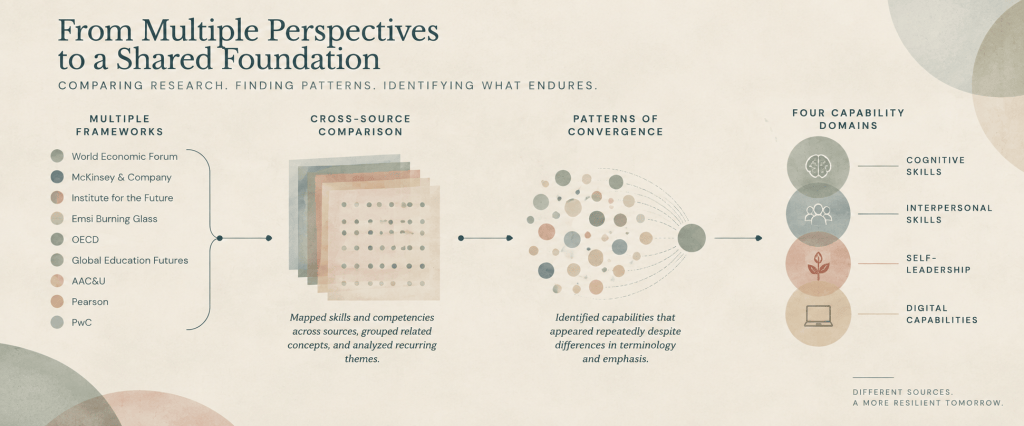
Rather than adopting a single future-skills framework, I compared multiple models to look for convergence. I mapped individual skills and competencies across sources, grouped related concepts, and looked for capabilities that appeared repeatedly despite differences in terminology and emphasis.
The resulting framework organized those patterns into four domains: cognitive skills, interpersonal skills, self-leadership, and digital capabilities.
What the Research Revealed
Across the frameworks, terminology varied, but several capabilities appeared repeatedly. The convergence was especially striking because the sources approached the future of work from different perspectives. Rather than pointing toward a single technical specialty, they repeatedly emphasized capabilities that help people think, relate, adapt, and work with technology.
Cognitive Skills
Critical and analytical thinking, creativity and innovation, and adaptability/flexibility emerged particularly strongly. Across the broader category, the research also surfaced problem-solving, sense-making, active learning, systems thinking, communication, and the ability to translate knowledge across contexts.
Interpersonal Skills
Collaboration, cross-cultural skills/global competence, and emotional/social intelligence showed the strongest convergence. Other recurring capabilities included negotiation, conflict resolution, facilitation, trust-building, coaching, and the ability to work effectively with different people and perspectives.
Self-Leadership
Self-control and regulation and self-motivation and wellness/resilience showed the strongest convergence across the frameworks. The broader category also included understanding one’s emotions and triggers, recognizing personal strengths, self-confidence, stress tolerance, courage and risk-taking, ownership and decisiveness, initiative, persistence, coping with uncertainty, and continued self-development.
Digital Capabilities
Digital literacy and programming literacy/design appeared particularly frequently, alongside capabilities including data literacy, data analysis, computational and algorithmic thinking, digital collaboration, digital ethics, cybersecurity literacy, and understanding digital systems.
Taken together, the findings suggested that preparing for uncertainty was less about predicting exactly which technical skills would be needed next and more about developing a portfolio of complementary capabilities. Technical fluency mattered, but so did the ability to think critically, work across differences, manage oneself, exercise agency, learn continuously, and adapt as conditions changed.
From Skills to Systems
Identifying future capabilities was only part of the problem. If these skills mattered, I wanted to understand what would need to change in the systems designed to develop them.
The research pointed toward implications across curriculum, student support, assessment, instructor development, and external collaboration. A stronger emphasis on transferable capabilities would require more than adding new content to existing courses. It would mean creating opportunities to practice skills across contexts, making those capabilities more visible, and reconsidering how learning is supported and assessed.
This shifted the question from “What should people learn?” to a broader organizational question: What conditions help people develop capabilities they can continue to use and adapt over time?
What I Took Forward
Looking back, what interests me most about this work is that the individual skills were only part of the finding. The more durable idea was the portfolio itself.
Preparing for uncertainty does not require knowing exactly what comes next. It requires developing different kinds of capability that work together: the ability to think and learn, work with others, manage oneself, and understand and adapt to changing technologies.
That idea continues to shape how I think about workforce development and organizational effectiveness. When conditions are changing quickly, the question is not only whether people possess the skills required today. It is whether they are developing the capacity to keep learning, adapting, and contributing as the work changes around them.
Project Details
Self-initiated research conducted at the College for Creative Studies in Spring 2022 to examine emerging future-of-work capabilities and their implications for education and workforce development.
Focus
Future of Work · Workforce Strategy · Foresight · Skills Development · Learning & Development
 Ashlei Watson