Learning & Development · Organizational Effectiveness · Leadership Development
WGU M.S. Management and Leadership Capstone · Applied Program Design
I developed this leadership-development model as the capstone for my M.S. in Management and Leadership. The project began with a practical organizational question: how might leadership development prepare people not simply to perform effectively within existing conditions, but to lead when those conditions are changing?
I designed a year-long developmental experience for current and emerging leaders that combined asynchronous learning, peer mentoring, reflection, applied practice, and competency assessment. The model began with self-awareness and expanded outward to decision-making, interpersonal dynamics, and environmental awareness.
The resulting program treated leadership development not as a series of isolated training experiences, but as a system for strengthening individual capability and organizational adaptability.
The Challenge
Leadership development is often organized around individual skills or management techniques. But leading through uncertainty requires something broader: the ability to understand oneself, make sound decisions with incomplete information, work effectively through relationships, and recognize changes occurring beyond the organization.
I wanted to design a developmental experience that treated those capabilities as interconnected rather than separate. The challenge was to create a program that could build progressively from individual awareness to a wider understanding of organizational and environmental context.
How could leadership development strengthen both individual capability and an organization’s capacity to adapt?
The Design Logic
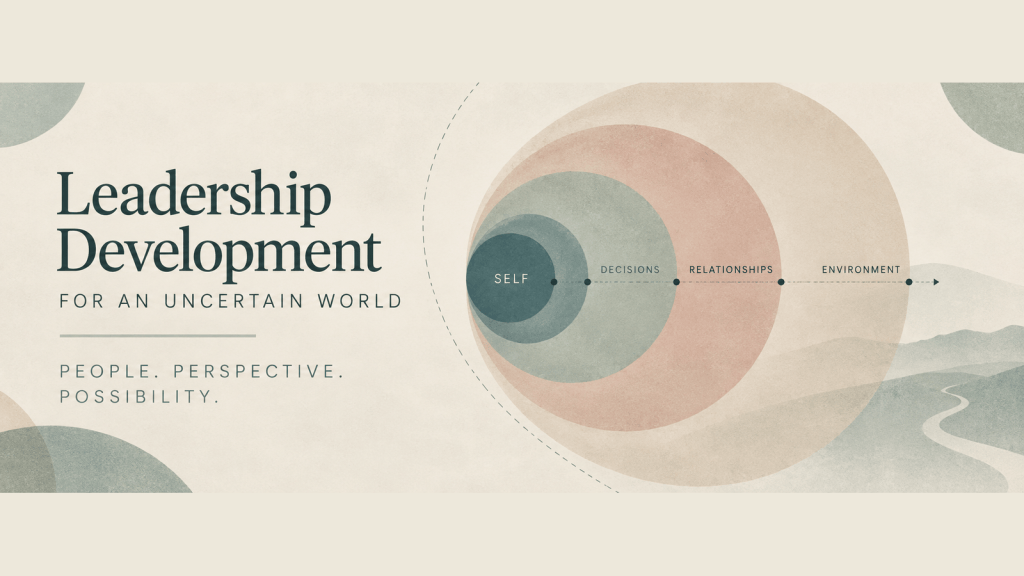
I structured the program as a progression outward. Participants would begin by examining how they think and respond, then move into decision-making and communication, interpersonal dynamics, and finally the larger environment in which the organization operates.
Each stage was intended to build on the one before it. The goal was not simply to accumulate leadership techniques, but to expand the participant’s field of awareness: from self, to decisions, to relationships, to environment.
The Program Architecture
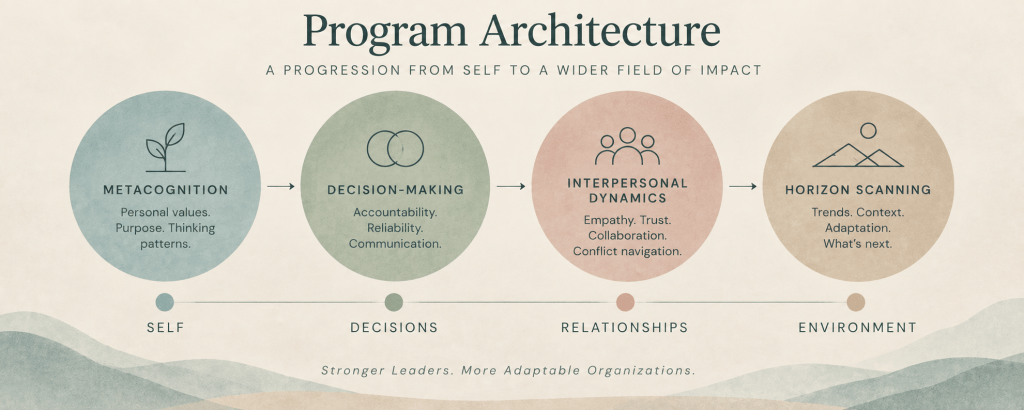
The capstone proposed four sequential courses:
1. Metacognition
Understanding cognitive bias, recognizing personal strengths and weaknesses, and developing greater awareness of how one’s thinking affects leadership behavior and decisions.
2. Decision-Making, Accountability, Reliability and Communication
Developing approaches to decision-making, accountability, trust, communication, and working through disagreement.
3. Interpersonal Dynamics
Building empathy, emotional intelligence, conflict management, collaboration, and the ability to work effectively with different personalities and perspectives.
4. Horizon Scanning
Looking outward to identify trends and emerging developments, assess their potential implications, and consider how leaders and organizations may need to adapt.
Designing for Transfer
The courses provided the content, but the design extended beyond instruction. I built reflection, peer mentoring, applied practice, and assessment into the program so participants would have repeated opportunities to connect what they were learning to how they actually led.
Participants would maintain a reflective journal throughout the year and meet regularly with peer mentors. Competency assessments before and after the program would provide another way to examine development, while a culminating presentation would ask participants to integrate what they had learned and consider how it applied to their leadership practice.
The intent was to create a developmental cycle: learn, apply, reflect, receive feedback, and apply again.
Designing for Scale
I also wanted the program to build capability beyond the individual participants in a single cohort. The model was designed so that graduates could become peer mentors and, over time, help facilitate subsequent cohorts.
That created a multiplier effect. Instead of relying indefinitely on a small number of program leaders or outside expertise, the organization could gradually develop an internal network of people equipped to support leadership development in others.
In that sense, the program was designed not only to develop leaders, but to strengthen the organization’s capacity to continue developing them.
What I Took Forward
Looking back, what stays with me most is the idea that leadership development should expand a person’s field of awareness. Effective leadership requires more than learning techniques. It requires understanding how our own thinking shapes what we see, how our decisions affect others, how relationships influence what is possible, and how changes in the larger environment may require us to reconsider familiar approaches.
The project also reinforced something I have continued to see in organizational work: development is more likely to matter when it is embedded in practice. Reflection, feedback, application, and relationships with others create opportunities to examine not only what we know, but how we are using that knowledge.
That has left me increasingly interested in a question that extends beyond leadership development: How do organizations help people recognize when ways of thinking and working that once served them well need to change?
Project Details
M.S. Management and Leadership capstone completed through Western Governors University in 2022. Developed as an applied program-design proposal for a year-long leadership-development experience.
Focus
Leadership Development · Learning & Development · Organizational Effectiveness · Capability Development · Program Design
 Ashlei Watson