
Research · Organizational Effectiveness · Governance
SCUP Emerging Leaders Program · Annual Conference Presentation
What happens to collaborative decision-making when the environment itself becomes unstable?
I developed this research project to explore how shared governance and consultative leadership function under conditions of profound uncertainty. The work brought together research on organizational decision-making, shared leadership, positive deviance, and anomie — a sociological concept describing periods when established norms and expectations begin to lose their hold.
The central question was not whether organizations should involve people in decisions. It was how they could preserve the benefits of participation while remaining capable of acting when familiar structures, assumptions, and ways of working were under pressure.
The Challenge
Consultative leadership can create space for diverse perspectives, subject-matter expertise, contextual knowledge, and greater acceptance of change. But participation also carries costs: gathering input takes time, individual agendas can shape discussion, and consultation can delay or redirect action.
Those tensions become more consequential when organizations are operating in unstable environments. The project considered a higher education sector already confronting demographic change, new competitors, changing expectations, questions about the value of credentials, rising costs, technological disruption, and declining confidence in institutions.
My question became: Are governance and leadership approaches designed for relatively stable environments sufficient when the environment itself is changing?
A Useful Lens: Anomie
Sociologist Émile Durkheim used anomie to describe a condition in which established norms and social structures lose their regulating force. I was interested in the concept as an organizational lens: what happens when people are expected to make decisions together while the assumptions, expectations, and structures that once helped organize those decisions are themselves becoming less stable?
Seen this way, uncertainty is not simply a problem of having insufficient information. It can also be a problem of weakened shared reference points — the rules, norms, relationships, and expectations people use to interpret information and decide what to do.
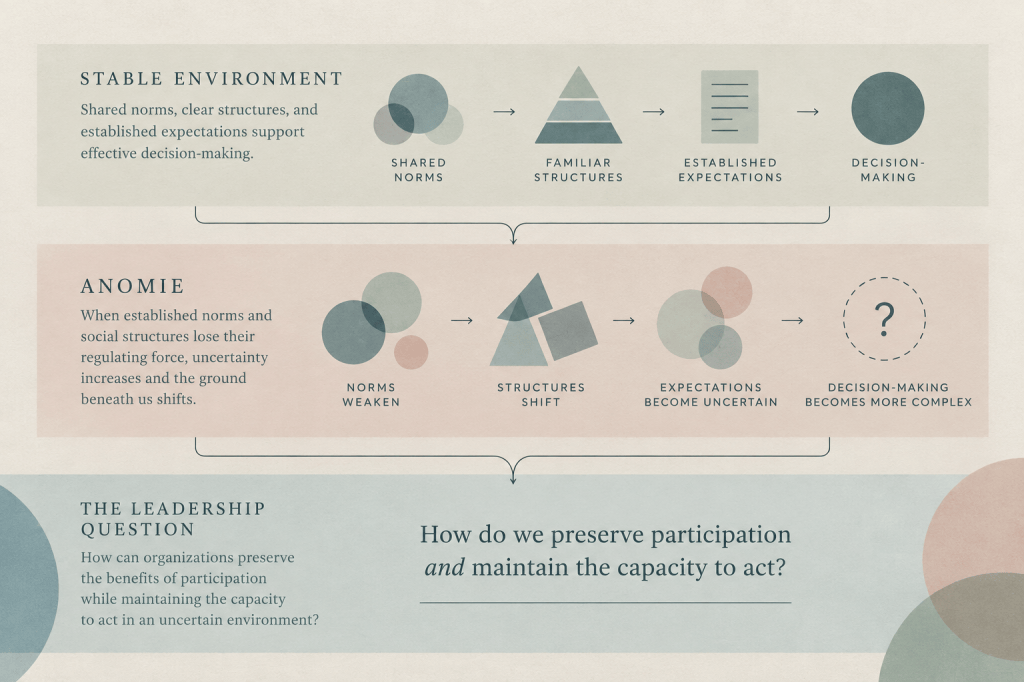
The Approach
I approached the problem by looking beyond formal governance structures to the conditions that support good decisions. Effective participation depends not only on who has a seat at the table, but on whether the right knowledge, perspectives, and context are available when a decision is being made.
I identified several forms of contextual knowledge that matter: understanding organizational fit, monitoring the external environment, considering current and future consequences, incorporating operational experience, and recognizing patterns, adjacencies, duplication, and opportunities for collaboration.
That led me to consider a more flexible model for participation: temporary, cross-functional innovation teams assembled around a particular problem or opportunity. Rather than relying exclusively on standing groups, these teams could bring together the people and expertise most relevant to the issue, operate within clear but limited guardrails, and prioritize the shared objective over the interests of individual areas.
The Design Principles
- Context before convention. Consider what the situation requires rather than defaulting automatically to an established process.
- Relevant perspectives over fixed representation. Bring together the people whose knowledge and experience are most useful to the problem.
- Guardrails without overcontrol. Establish enough structure to maintain direction while preserving room for exploration and adaptation.
- Shared purpose over individual agendas. Organize participation around the problem to be solved rather than the interests of particular functions.
- Adapt the structure to the work. Use temporary configurations when a permanent committee or hierarchy is not the best mechanism for the problem at hand.
The objective was not to replace shared governance or consultation. It was to make participation more responsive to context: preserving diverse perspectives and organizational knowledge while increasing the capacity to act when circumstances demand it.
What I Took Forward
Looking back, what interests me most about this work is the distinction between participation and responsiveness. Organizations need mechanisms for bringing multiple perspectives into decisions, but those mechanisms also need to remain appropriate to the environment in which decisions are being made.
The project reinforced my interest in the role of context in organizational effectiveness. Processes that work well under one set of conditions can become less useful when circumstances change. Structures designed to create stability can eventually constrain adaptation if maintaining the structure becomes more important than responding to the problem.
It also left me with a question that continues to shape my work: How do organizations recognize when the assumptions, norms, and processes that once helped them succeed have become obstacles to seeing what has changed?
Project Details
Developed through SCUP’s Emerging Leaders Program and presented at the SCUP Annual Conference at the conclusion of the year-long program.
Focus
Organizational Leadership · Shared Governance · Decision-Making · Anomie · Positive Deviance · Shared Leadership
 Ashlei Watson