
Research · Foresight · Organizational Change · AI Strategy
The Question
How should a creative institution respond when a technology is developing faster than organizational policy, shared understanding, and established practice?
My Role
From 2022 onward, I worked across research, planning, communication, governance, and experimentation to help colleagues understand emerging AI capabilities and implications. My work included institutional working groups, presentations and webinars, policy development, curriculum review, employee resources, and experimentation with AI-enabled research tools.
Much of this work involved proprietary institutional materials, collaborative authorship, or internal presentations and cannot be reproduced publicly. This case study describes the context, questions, methods, and contributions behind the work.
What the Work Involved
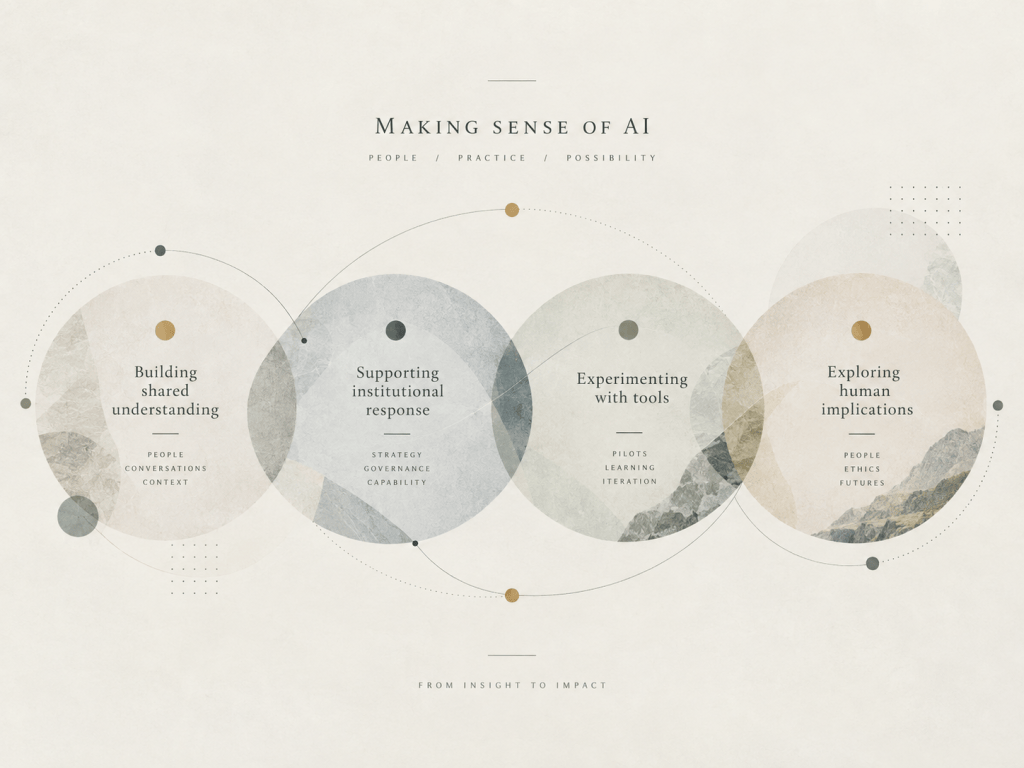
Building Shared Understanding
Researched developments in generative AI and translated them into presentations, webinars, and facilitated discussions for different audiences. This included SCUP webinars, internal presentations on AI in the Creative Industries and AI and the Future of Work, and student and faculty/staff town halls exploring questions, concerns, and emerging expectations around AI.
Supporting Institutional Response
Co-chaired the AI Working Group and participated in ongoing AI implementation work. Contributed to employee-facing resources, reviewed emerging AI-related curriculum, and co-wrote the institution’s AI statement. The work required balancing experimentation with questions about academic integrity, creative practice, workforce implications, ethics, and institutional responsibility.
Experimenting with AI Tools
Used generative AI as part of my own research practice and developed purpose-built workflows using tools such as Gemini Gems and NotebookLM. These experiments explored how AI might support environmental scanning, trend analysis, research synthesis, structured inquiry, and knowledge retrieval while also revealing the importance of source quality, framing, and human review.
Exploring AI Through Speculative Fiction
AI also became a subject of creative inquiry. I co-authored two speculative novels, Private I (2023) and After Image (2025), which examine questions of technology, identity, agency, and human judgment. Fiction offered a different way to explore consequences that conventional organizational analysis does not always capture.
What I Learned
One of the most important lessons was that AI adoption is rarely primarily a technology problem. It is a sensemaking problem. People need ways to understand what is changing, question assumptions, experiment safely, and decide what should or should not change as a result.
 Ashlei Watson